
 Aster Yellows
At a glance
| Type | Phytoplasma (a tiny, wall-less bacterium-like organism) |
| Main cause | Candidatus Phytoplasma asteris, carried by the aster leafhopper |
| Worst conditions | Summers when leafhoppers are plentiful, especially near weedy edges |
Recent community discussions
No one has talked about Aster Yellows yet. Be the first.
Signs
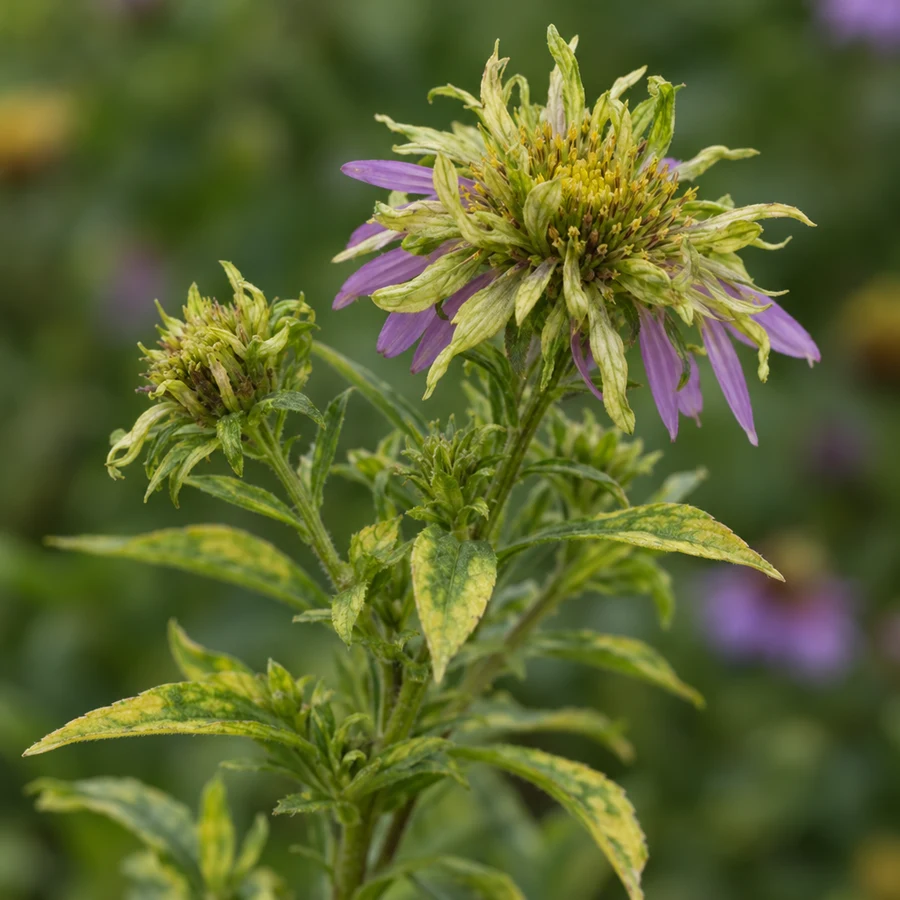
- Leaves turn pale yellow, usually starting with the new growth, and the veins can go pale too (Iowa State).
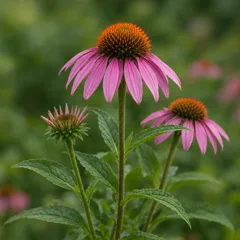
- Flowers stay green, look leafy or twisted, and may grow odd tufts from the flower head (very typical on Echinacea and Black-Eyed Susan).
- Stems grow upright and spindly, with a "witches' broom" of thin shoots.
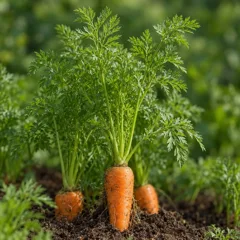
- On carrots, the tops go bushy and yellow or reddish, and roots are small, hairy and bitter.
- Plants don't usually wilt or die quickly, which helps tell it apart from wilts and root rots.
Cause and Spread
Aster yellows is caused by a phytoplasma that lives in the plant's sap-carrying tissue. It can't spread by touch, water or tools. The aster leafhopper picks it up by feeding on an infected plant, and after a wait of 2 to 3 weeks it can infect healthy plants for the rest of its life. It has a huge host range (more than 300 species), and infected perennials and weeds such as dandelions and plantain can keep it going in the garden for years.
Prevention
- Pull weeds in and around the garden, especially dandelions, plantain and wild carrot, which can hold the disease.
- Check plants through summer and remove anything suspicious early, before leafhoppers feed on it.
- Cover carrots and other high-value crops with fine row cover to keep leafhoppers off.
- Yellow sticky cards help you see when leafhoppers arrive.
- Don't replant susceptible flowers in the same spot after a bad year if infected weeds are nearby.
Is There a Cure?
- No. Once a plant shows symptoms, it stays infected.
- Spraying leafhoppers in home gardens rarely works well enough to stop the disease, so focus on removal and weed control instead (University of Wisconsin).
When to Pull the Plant
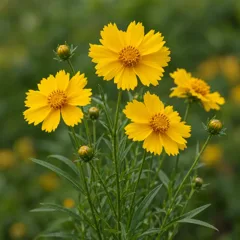
Pull any plant with symptoms as soon as you're sure, roots and all. You can bag it for the trash, or bury it in the compost pile or the soil: the phytoplasma can only live inside a living plant, so it dies along with the plant (SDSU). This matters most for perennials like Echinacea, Coreopsis and Black-Eyed Susan, because an infected clump comes back every year and keeps feeding the disease to new plants.
Sources
- UConn Extension IPM, "Aster Yellows on Herbaceous Perennials": https://ipm.cahnr.uconn.edu/?p=15691
- University of Wisconsin Plant Disease Diagnostics Clinic, Aster: https://pddc.wisc.edu/tag/aster/
- University of Wisconsin-Madison Extension, Aster yellows: https://hort.extension.wisc.edu/articles/aster-yellows/
- University of Illinois Extension, Aster yellows: https://extension.illinois.edu/plant-problems/aster-yellow
- South Dakota State University Extension, Aster yellows phytoplasma: https://extension.sdstate.edu/aster-yellows-phytoplasma
- University of Maryland Extension: https://extension.umd.edu/node/2653
- Iowa State University Extension, Aster yellows: https://yardandgarden.extension.iastate.edu/encyclopedia/aster-yellows
- Ontario Ministry of Agriculture, Aster leafhopper and aster yellows: https://ontario.ca/page/aster-leafhopper-and-aster-yellows
Plants it affects 7
Recent community discussions
No one has talked about Aster Yellows yet. Be the first.



