
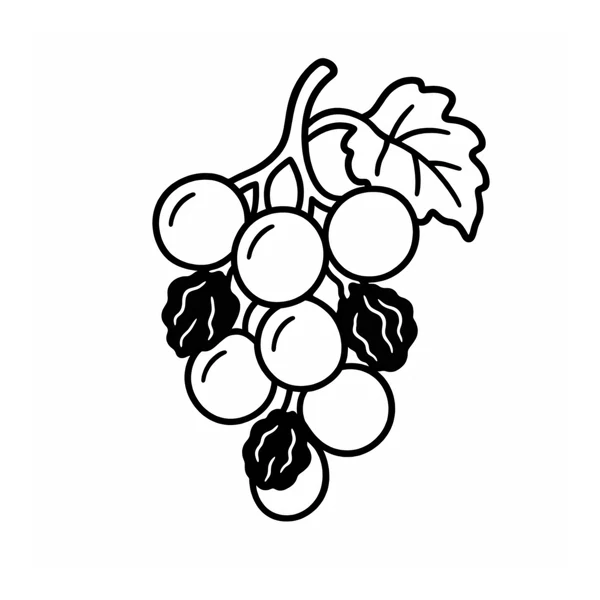
 Grape Black Rot
At a glance
| Type | Fungus |
| Main cause | Guignardia bidwellii (also called Phyllosticta ampelicida) |
| Worst conditions | Warm, wet spring and early summer weather, with leaves staying wet for about six hours at around 80°F |
Recent community discussions
No one has talked about Grape Black Rot yet. Be the first.
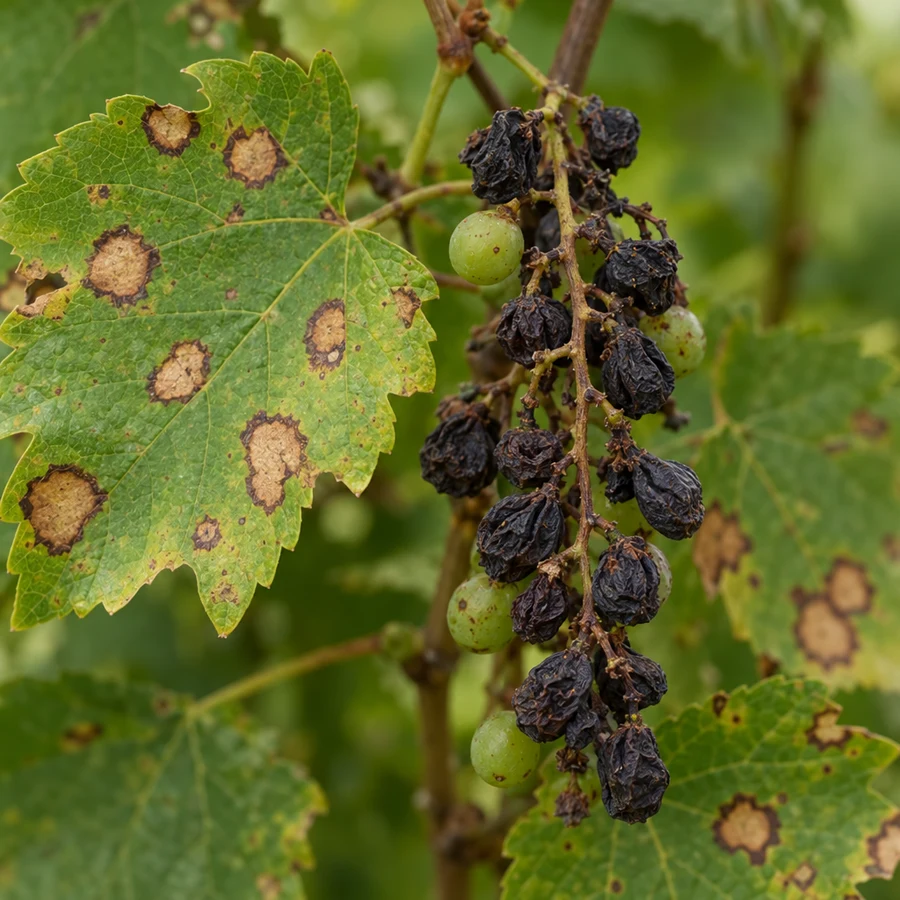
If you're finding black spots on grapes, and berries shriveling into hard little raisins while still on the vine, black rot is the usual culprit. It's one of the most damaging diseases of grapes in the eastern and central US, and in a wet year it can take most of the crop by turning the berries into hard, black, shriveled "mummies". This is a different disease from black rot of cabbage and its relatives (see Brassica Black Rot).
Signs
- Small, round, tan to reddish-brown spots on the leaves, with a dark border.
- Tiny black dots (the fungus's spore bodies) inside the leaf spots.
- Dark, sunken, stretched-out spots on young shoots, leaf stalks and tendrils.
- Berries first show a pale spot, then turn brown, then shrivel into hard black mummies covered in tiny black dots.
- Mummies often stay hanging in the bunch or fall to the ground under the vine.
Cause and Spread
The fungus spends the winter in mummified berries, on the vine and on the ground, and in old infected canes. Spring rain soaks the mummies and they shoot spores into the air, which land on new leaves, shoots and young fruit. Infection can start once leaves stay wet for about six hours at around 80°F; when it's cooler they need to stay wet much longer, closer to a full day at 50°F. Young berries are most at risk in the first two to three weeks after bloom. They become resistant about 4 to 5 weeks after bloom on American types like Concord, and up to 6 to 8 weeks after bloom on European wine grapes. Spots from a late infection may stay hidden until the berries start to color.
Prevention
- Sanitation is the most important step: pick every mummy off the vine and the ground, and throw it away (not in the compost).
- Prune out old, infected canes and tendrils while the vine is dormant (see prune grapevines in late winter).
- Prune and train the vine so the canopy is open and dries quickly after rain.
- Plant in full sun with good air movement, never in a damp, sheltered hollow.
- Keep weeds and grass under the vine short so the area dries out.
- European wine grapes (vinifera) are very susceptible; some American and hybrid grapes hold up better, but no variety is fully resistant.
Organic Treatment
- Wondering how to treat black rot on grapes? Start with the fact that no spray cures a berry that's already infected. The aim is to protect new growth before the rain does its work.
- Keep picking off spotted leaves and shriveling berries all through the season.
- In wet years, or where black rot turns up every year, protect the vine from just before bloom until about 4 to 6 weeks after bloom. That's the stretch that matters most for the fruit.
- Organic protectants include sulfur and copper products such as Bordeaux mixture. Pick one that is OMRI-listed and labeled for grapes, follow the label for rates and spray intervals, and expect to reapply after heavy rain.
- Some American grapes, Concord among them, can be scorched by sulfur, and copper can burn leaves in cool, slow-drying weather. Check the label for your variety before you spray.
- Your local extension office can tell you which products and timings suit your area.
When to Pull the Plant
You don't need to pull the vine. Black rot rarely kills grapes; it ruins fruit. If it's bad every year, a thorough mummy clean-up, harder pruning or switching to a more resistant variety is the fix.
Sources
- University of Maine Cooperative Extension, Black Rot of Grape (Fact Sheet 5106): https://extension.umaine.edu/ipm/ipddl/publications/5106e/
- UMass Extension Fruit Program, Grape IPM: Black Rot: https://www.umass.edu/agriculture-food-environment/fruit/fact-sheets/grape-ipm-black-rot
- Oklahoma State University Extension, Black Rot of Grapes: https://extension.okstate.edu/fact-sheets/black-rot-of-grapes
- University of Illinois Extension, Reports on Plant Diseases RPD 703: https://ipm.illinois.edu/diseases/series700/rpd703
- Ontario Ministry of Agriculture, Food and Agribusiness (OMAFA), Black Rot of Grapes: https://www.omafra.gov.on.ca/IPM/english/grapes/diseases-and-disorders/black-rot.html
- Michigan State University Extension, Disease control in grapes critical during and after bloom: https://www.canr.msu.edu/news/disease_control_in_grapes_critical_during_and_after_bloom
- Penn State Extension, Black Rot on Grapes in Home Gardens: https://extension.psu.edu/black-rot-on-grapes-in-home-gardens
Plants it affects 1
Recent community discussions
No one has talked about Grape Black Rot yet. Be the first.
Products that take care of Grape Black Rot
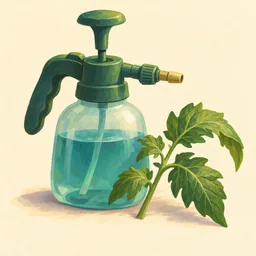 Copper FungicideOrganic spray that protects leaves from blights, leaf spots and bacterial diseases.See it →
 Biofungicide (Bacillus subtilis)Friendly bacteria that crowd out mildews, gray mold and leaf spots.See it →
 Soaker HoseWaters the roots slowly, not the leaves: less disease, less water, less work.See it →
