
 Citrus Canker
At a glance
| Type | Bacterium |
| Main cause | Xanthomonas citri subsp. citri |
| Worst conditions | Warm, rainy, windy weather, especially tropical storms, and leaves damaged by citrus leafminer |
Recent community discussions
No one has talked about Citrus Canker yet. Be the first.
Citrus canker is a regulated disease. In the US it's found all over Florida and in limited areas of Alabama, Louisiana and Texas, and those places are under quarantine. The rules limit what can leave a quarantine area: commercial fruit and nursery stock can only go out under a federal permit, and home growers shouldn't move any citrus plants, fruit, cuttings or clippings out at all. Never carry citrus plants, cuttings or fruit across state lines.
Signs
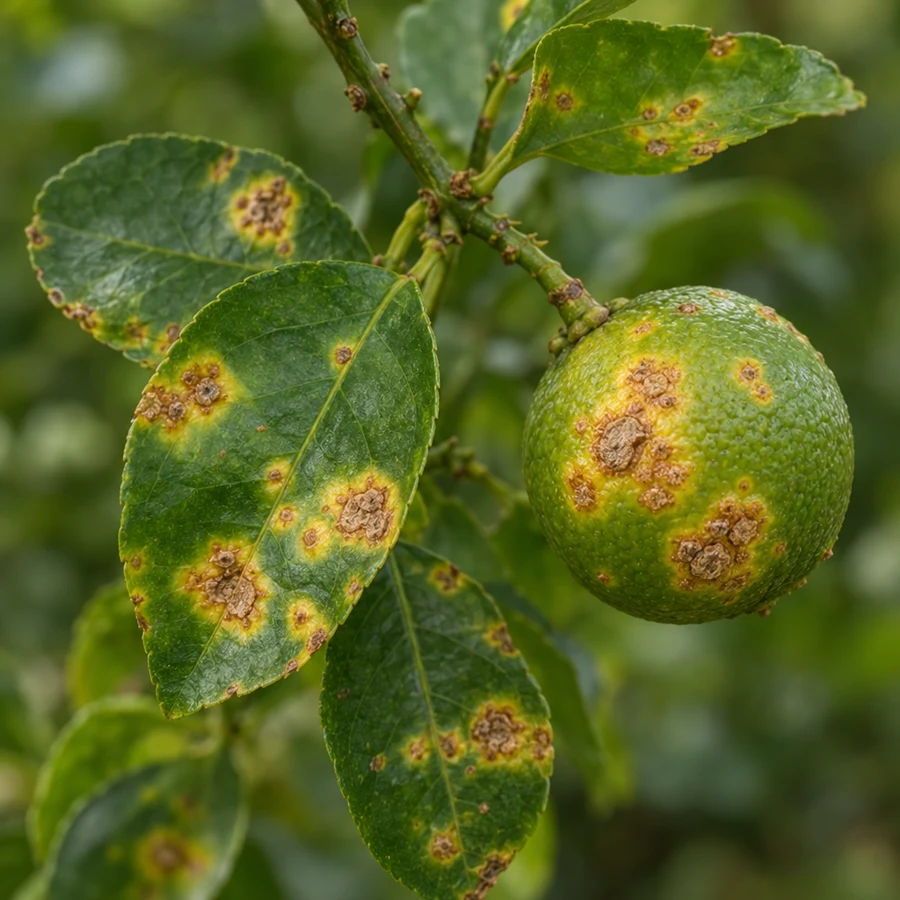
- Raised, corky, tan to brown spots on leaves, stems and fruit.
- On leaves, the spots show on both sides and often have a yellow halo around them.
- Spots on fruit are rough and scabby; badly hit fruit may drop early.
- Older spots can have a sunken, crater-like center.
- Heavy infection causes leaf drop, twig dieback and a weaker tree.
Look-alikes
A few other problems leave spots on citrus, so check these before you worry:
- Citrus scab: a fungus that makes bumpy, wart-like pustules, often cone-shaped. They usually stick up on just one side of the leaf and don't have a yellow halo.
- Bacterial spot: mostly a nursery problem. The spots stay flat rather than raised, and they rarely show up on fruit.
- Greasy spot: a fungus that starts as yellowish blotches and turns into dark, slightly oily-looking patches, mainly on the underside of older leaves. The spots are flat, not corky.
If you're not sure, take clear photos of the top and the underside of affected leaves, plus any spotted fruit and stems, and send them to your county extension office. Put a coin or ruler in a couple of shots so they can judge the size.
Cause and Spread
The bacteria get into leaves, stems and fruit through natural pores and through wounds, including the tunnels made by citrus leafminer. Wind-driven rain splashes them from tree to tree, and storms can carry them a long way. People spread them too, on hands, clothes, tools and by moving infected plants or fruit.
Prevention
- Buy citrus only from certified, licensed nurseries; never bring in plants from another state.
- Don't move fruit, leaves or cuttings off your property if you live in a quarantine area.
- Wash hands and clean pruning tools after working on citrus, and before touching anyone else's tree.
- Keep citrus leafminer in check so leaves aren't wounded.
- Water at the soil, not over the leaves.
Organic Treatment
- There is no cure for an infected tree.
- Copper sprays labeled for citrus can protect new growth and young fruit from new infections (UF/IFAS). Always follow the label.
- In Florida, report a suspected case to the state first, and only prune or remove anything once they've been told.
- Prune out badly infected twigs in dry weather and clean tools between cuts.
- Double-bag the pruned twigs, leaves and fallen fruit and send them to the landfill. Don't compost them. Your state may have stricter disposal rules, so check with your extension office.
When to Pull the Plant
If you think you see citrus canker, contact your state department of agriculture or county extension office before you do anything; they'll confirm it and tell you what the local rules require. A tree that's in steep decline is usually best removed, following their advice on disposal.
Sources
- UF/IFAS Extension, Homeowner Fact Sheet: Citrus Canker (PP116): https://journals.flvc.org/edis/article/view/106490
- UF/IFAS Extension, Field Identification of Citrus Canker Symptoms and Decontamination Procedures (PP136): https://journals.flvc.org/edis/article/view/115184
- USDA APHIS, Citrus Canker: https://www.aphis.usda.gov/plant-pests-diseases/citrus-diseases/citrus-canker
- Texas A&M AgriLife Extension, Fort Bend County, Citrus Canker Disease: https://fortbend.agrilife.org/files/2017/01/Citrus-Canker-Disease-in-Fort-Bend-County-17.01.10.pdf
Plants it affects 3
Recent community discussions
No one has talked about Citrus Canker yet. Be the first.
Products that take care of Citrus Canker
 Copper FungicideOrganic spray that protects leaves from blights, leaf spots and bacterial diseases.See it →
 Biofungicide (Bacillus subtilis)Friendly bacteria that crowd out mildews, gray mold and leaf spots.See it →
 Soaker HoseWaters the roots slowly, not the leaves: less disease, less water, less work.See it →
