
 Fusarium Head Blight (Scab) in Barley
At a glance
| Type | Fungus |
| Main cause | Fusarium graminearum (and related Fusarium species) |
| Worst conditions | Warm, wet, humid weather while the heads are coming out and flowering, and old wheat, barley or corn stubble nearby |
Recent community discussions
No one has talked about Fusarium Head Blight (Scab) in Barley yet. Be the first.
Join free to talk about Fusarium Head Blight (Scab) in Barley ›
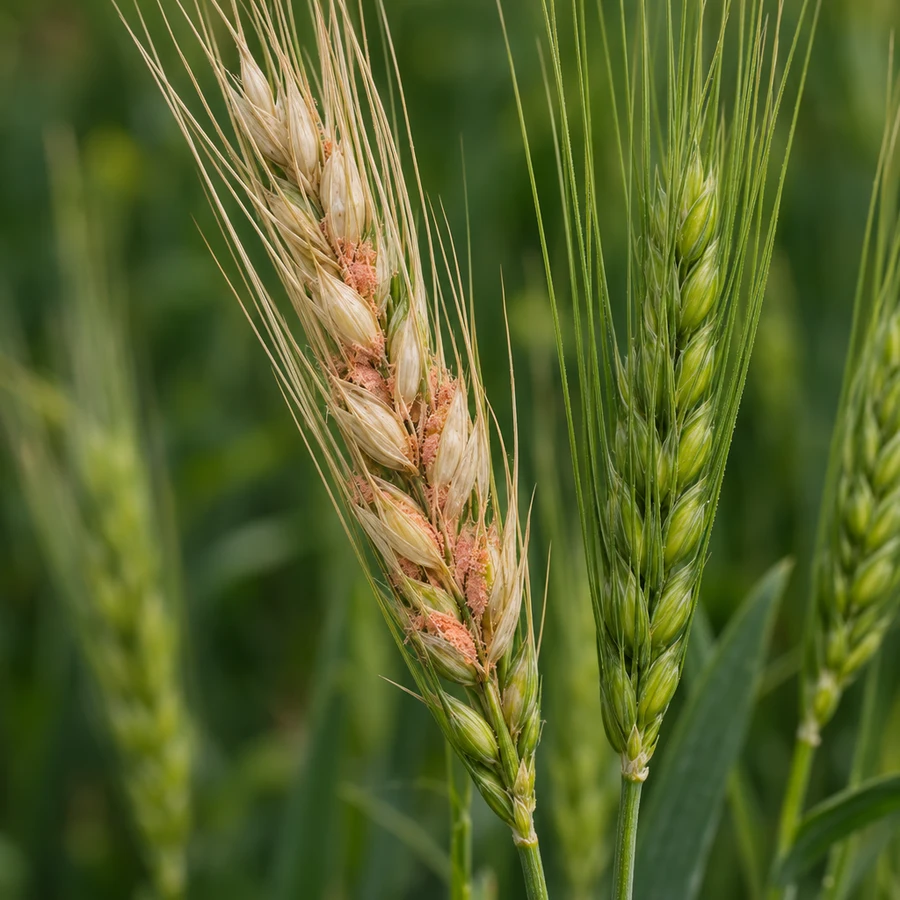
Fusarium head blight, often just called scab, infects the grain heads of barley and wheat. Besides shriveled grain, the fungus can leave a toxin (vomitoxin, or DON) in the kernels, so badly scabbed grain shouldn't be eaten, malted or fed to animals.
Signs
- Single spikelets, or whole sections of the head, turn pale or bleached early while the rest stays green.
- In barley the infection often shows as scattered single kernels and spreads along the head less than in wheat, so it can be harder to spot.
- Infected kernels look tan or brown, and sometimes have a pinkish or salmon-orange tinge, mostly where the kernel joins the head.
- Kernels from infected heads are small, shriveled and light.
Cause and Spread
The fungus spends the winter on crop stubble, especially wheat, barley and corn left on the soil surface. In warm, wet weather it makes spores that blow or splash onto the heads. Barley is most open to infection from the time the heads come out, through flowering and into early grain fill. Long spells of rain, dew and high humidity in that window are when scab gets bad.
Prevention
- Don't sow barley straight after corn, wheat or barley; rotate with other crops.
- Clear away or bury old grain and corn stubble before sowing.
- Sow clean, good-quality seed.
- Pick varieties listed as less susceptible to scab, though no barley variety is fully resistant.
- Sow so the heads come out outside your usual wettest weeks, where you can. Look up barley sowing times for your zone to plan it.
Organic Treatment
- There's no organic treatment that cures scab once a head is infected.
- Cut off badly bleached heads and throw them away rather than leaving them to shed spores and infected grain.
- Harvest promptly when the grain is ready, and dry it well before storing.
- Throw away shriveled, pink or chalky kernels. Don't eat, sprout or malt grain from badly scabbed heads, because of the toxin.
- Seed treatments only help with seedling problems; they won't protect the heads.
When to Pull the Plant
You don't usually need to pull whole plants. Remove heads that are badly bleached or show pink mold, and if most of the patch is infected, discard that harvest and clear the stubble so it doesn't carry the disease to next year.
Sources
- North Dakota State University Extension, Fusarium Head Blight (Scab) of Small Grains (PP804): https://ndsu.edu/agriculture/sites/default/files/2024-10/pp804.pdf
- Montana State University Extension, Fusarium Head Blight (Scab) of Wheat and Barley (MT200806AG): https://extension-store.montana.edu/montguides/fusarium-head-blight-scab-of-wheat-and-barley
- Michigan State University, Managing Fusarium Head Scab of Malting Barley: https://www.canr.msu.edu/uploads/resources/pdfs/managing_fusarium_head_scab_of_malting_barley.pdf
- Penn State Extension, Heads Up, Barley Heads Are Out!: https://extension.psu.edu/heads-up-barley-heads-are-out
Plants it affects 1
Recent community discussions
No one has talked about Fusarium Head Blight (Scab) in Barley yet. Be the first.
Join free to talk about Fusarium Head Blight (Scab) in Barley ›



