
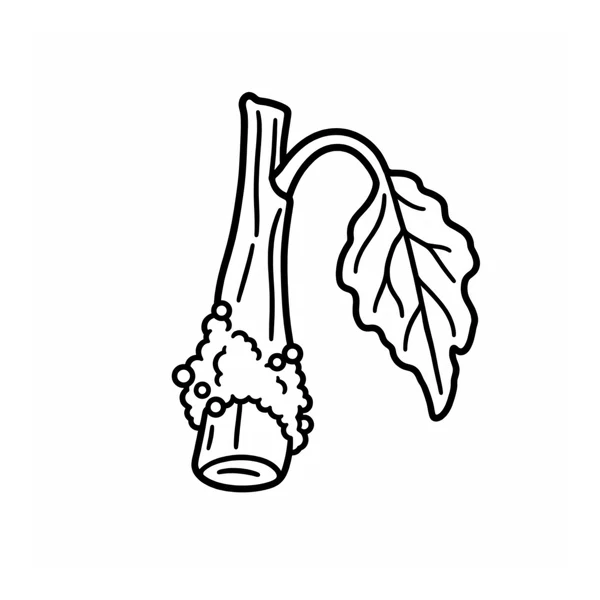
 Southern Blight
At a glance
| Type | Fungus |
| Main cause | Agroathelia rolfsii (formerly Athelia / Sclerotium rolfsii) |
| Worst conditions | Hot weather (about 80–95°F), moist soil, and undecayed plant debris or mulch against the stems |
Recent community discussions
No one has talked about Southern Blight yet. Be the first.
Southern blight is a soil fungus of hot summers that attacks more than 500 kinds of plants, including okra, tomatoes, peppers, beans, melons and many flowers. It rots the stem right at the soil line, so plants collapse quickly. It's most common in the South but turns up farther north in hot spells.
Signs
- The plant wilts suddenly, often while it still looks green.
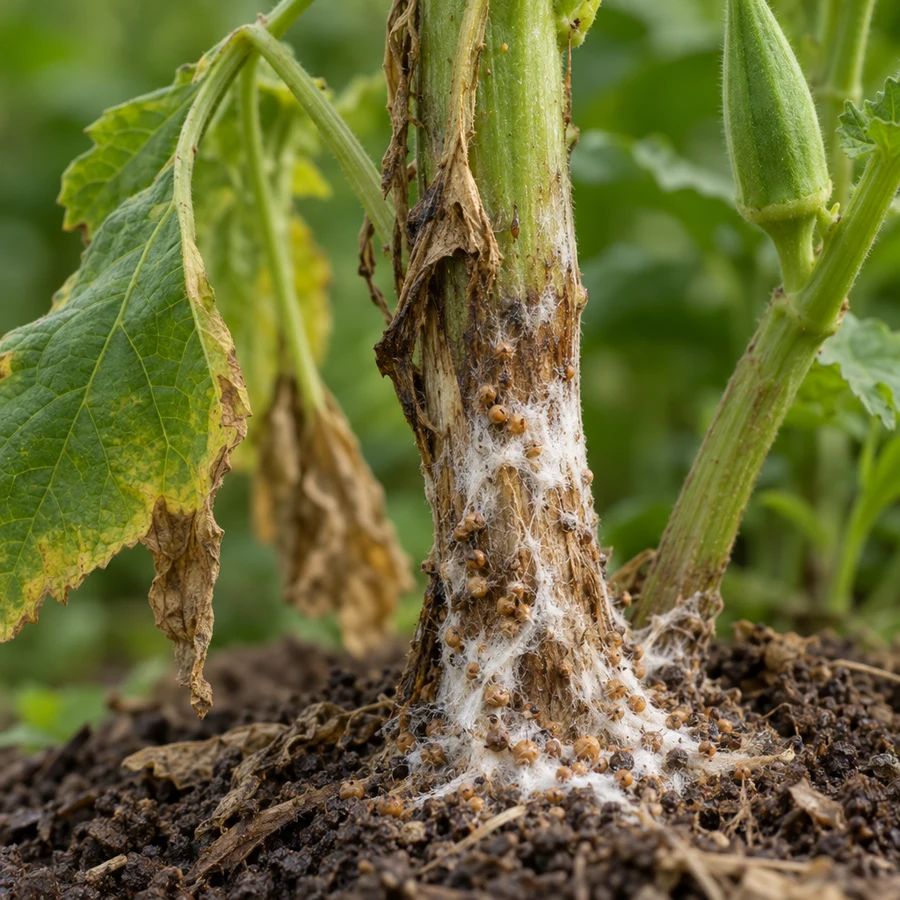
- A brown, rotten, sunken patch on the stem at or just below the soil line.
- A thick, white, cottony mat of fungus around the stem base and on the soil nearby.
- Hard little balls (sclerotia), 1 to 2 mm across, dotted through the white growth. They start out cream and darken to brown as they age.
- Pods or fruit touching the soil may rot with the same white growth.
Cause and Spread
The fungus lives in the top few inches of soil as sclerotia, which can last for years. They come through mild winters well, but long, hard freezes kill many of them, which is why the disease is mostly a Southern problem. In hot, moist weather they sprout and the fungus grows along the soil surface, feeding on dead plant matter before attacking stems. It spreads by moving soil, on tools, in water runoff, and on infected transplants. Many weeds can host it too.
Prevention
- Inspect transplants and don't plant any with rot or white growth at the base.
- Rotate: follow okra and other hosts with corn or grains, which the fungus doesn't attack. Check your zone's planting calendar to see when corn goes in where you live, and see our crop rotation plan for laying out the beds.
- Dig plant debris in deeply or remove it, and keep fresh mulch from touching the stems.
- Keep the area weed-free, since weeds can carry it.
- Water the soil but avoid keeping the stem base constantly wet.
- In a bed that has had it, turning the soil deeply before planting buries the sclerotia so fewer sprout.
Organic Treatment
- Nothing saves a plant whose stem is already rotted through.
- Remove the sick plant, the white growth and the top few inches of soil around it, and bag them for the trash, not the compost.
- Pull mulch back from the stems of nearby plants so the soil surface dries.
- Fungicides are mainly used by commercial growers before disease appears; check your local extension guide and the label if you consider one.
When to Pull the Plant
Pull any plant with a white mat and rot at the stem base as soon as you see it. It won't recover, and leaving it lets the fungus make many more sclerotia. Our fall clean-up guide covers clearing out sick plants at the end of the season.
Sources
- NC State Extension, Southern Blight of Vegetable Crops: https://content.ces.ncsu.edu/southern-blight-of-vegetable-crops
- University of Wisconsin Plant Disease Diagnostics Clinic, Southern Blight: https://pddc.wisc.edu/2019/01/06/southern-blight-2/
- University of Kentucky, Southern Blight (PPFS-GEN-16): https://darktobacco.mgcafe.uky.edu/sites/darktobacco.ca.uky.edu/files/ppfs-gen-16.pdf
- Clemson Cooperative Extension, Land-Grant Press, Managing Southern Blight on Vegetable Crops (LGP 1009): https://lgpress.clemson.edu/publication/managing-southern-blight-on-vegetable-crops/
Plants it affects 1
Recent community discussions
No one has talked about Southern Blight yet. Be the first.
Products that take care of Southern Blight
 Biofungicide (Bacillus subtilis)Friendly bacteria that crowd out mildews, gray mold and leaf spots.See it →
 Seed Starting TrayReusable tray with a clear dome to give seeds a warm, humid start indoors.See it →
 Soaker HoseWaters the roots slowly, not the leaves: less disease, less water, less work.See it →
Products that take care of Southern Blight
SB Plant InvigoratorA non-toxic spray that controls mildew and many bugs by contact, and feeds the leaves as it goes.See it →Seed Starting TrayReusable tray with a clear dome to give seeds a warm, humid start indoors.See it →Soaker HoseWaters the roots slowly, not the leaves: less disease, less water, less work.See it →