Every ear of sweet corn in a backyard bed goes back to a wild grass on the hillsides of southwest Mexico. Here is how it changed, how it spread, and how to grow it.
A wild grass called teosinte
Corn's wild ancestor is teosinte, a leafy grass that still grows in Mexico. Each little ear holds only five to twelve kernels, and every kernel is sealed in a case as hard as a pebble. In the 1930s the geneticist George Beadle showed that teosinte and corn are close relatives. He also popped teosinte kernels in a pan to show people could have eaten them.
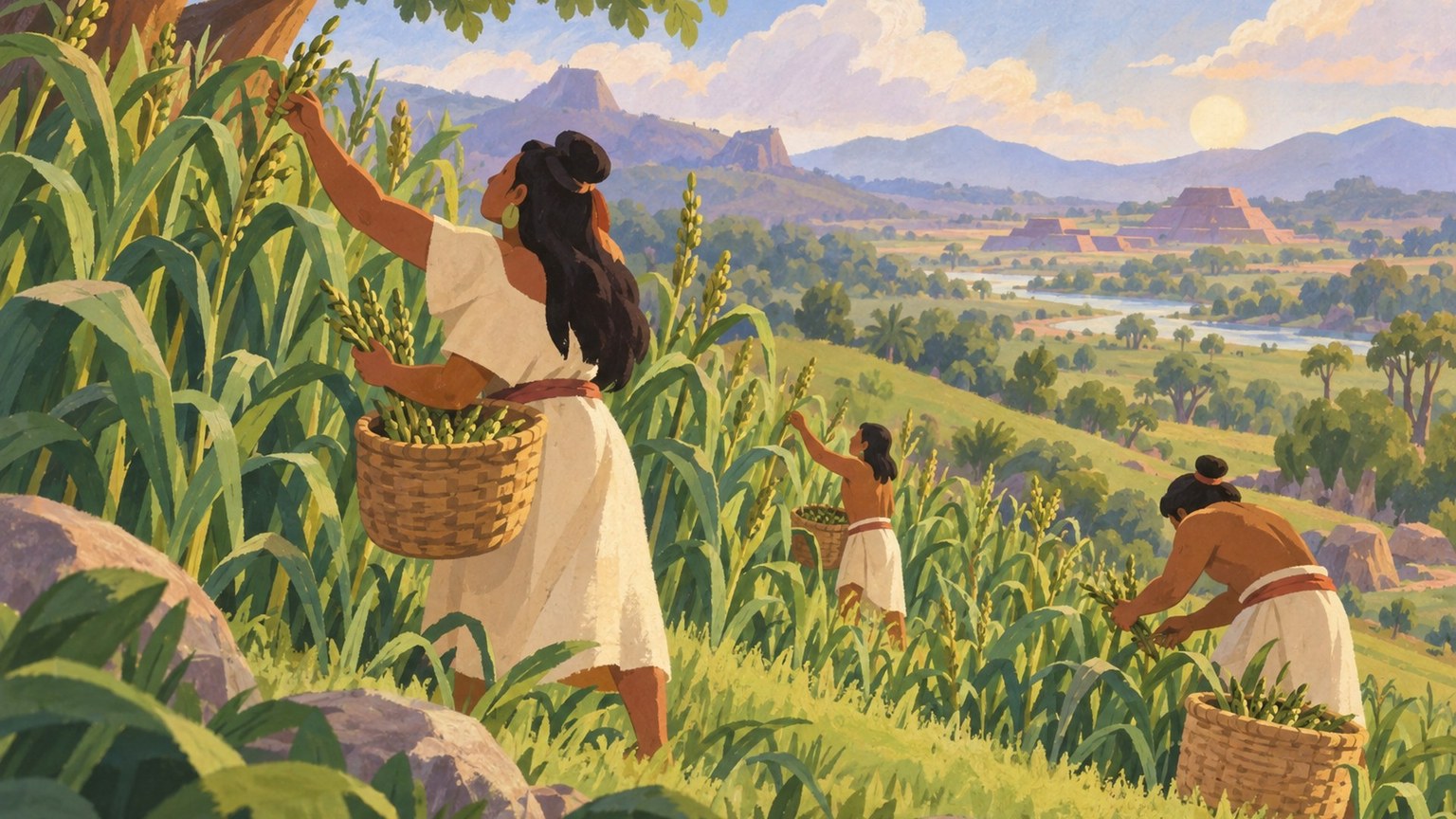
DNA studies point to the Balsas River valley as the place where corn began, about 9,000 years ago. Year after year, farmers saved seed from their best plants: bigger ears, softer kernels, heads that held their seed. Some of the oldest cobs ever found, from Guilá Naquitz cave in Oaxaca, are about 6,200 years old and smaller than your little finger.
Along the way corn lost the power to sow itself. Its kernels stay wrapped tight in the husk, so without people to plant it, it would die out.
People of maize
Maize became the heart of life across Mexico and Central America. In the Popol Vuh, the sacred book of the K'iche' Maya, the gods fail to make people from mud, then from wood, and at last shape them from maize dough.
Cooks simmered dried corn with lime or wood ash (nixtamalization). It softens the kernels for tortillas and frees niacin, a vitamin the body needs.
North, south and the Three Sisters
Maize spread from village to village, carried as seed. It reached South America more than 6,000 years ago (cobs about 6,700 years old from coastal Peru include popcorn), and the deserts of today's Arizona and New Mexico over 4,000 years ago. By about a thousand years ago it fed Cahokia on the Mississippi and villages as far as the St. Lawrence River.
In the northeast, the Haudenosaunee (Iroquois) grow corn, beans and squash together and call them the Three Sisters:
- Corn gives the beans a pole to climb.
- Beans help feed the soil: bacteria in their roots take nitrogen from the air.
- Squash shades the ground with its big leaves, holding moisture and smothering weeds.
By tradition, the sisters are planted, grown and eaten together. In 1621 the settlers at Plymouth wrote that a Patuxet man, Tisquantum (Squanto), showed them how to plant corn with a fish in each hill.
Across the ocean
In November 1492, Columbus's journal mentions a grain the people of Cuba called mahiz. That Taíno word became "maize", and Spanish ships probably carried the seed home on his first voyage back. Within a century corn grew across southern Europe, and polenta became everyday food in Italy. The English called it "Turkey wheat", and Italians still call it granoturco. Portuguese traders took it to Africa, where it is now a main food from Kenya to Zambia, and it reached China by the mid-1500s.
Lime cooking didn't travel with the seed. Where poor families lived mostly on corn, a disease called pellagra followed, in Italy, Spain and later the American South. In the 1910s Dr Joseph Goldberger showed it came from diet, not germs. The missing piece was niacin.
The Corn Belt and hybrid corn
Settlers moving west in the 1800s found deep, black soil under the prairie. The story goes that in 1846 Robert Reid brought a reddish corn from Ohio to Illinois, filled the gaps with an early yellow corn, and the two crossed. Reid's Yellow Dent won a prize at the Chicago World's Fair in 1893.
Breeders later found that crossing two inbred lines gave plants stronger than either parent, but their seed doesn't grow true. Hybrid seed spread fast: under 1% of Iowa's corn in 1933, almost all of it by 1943. American farms now harvest about seven times as much corn per acre as in the 1930s, and corn is the most grown grain on Earth.
Four kinds of corn
| Kind | What it is | Best for |
|---|---|---|
| Dent | The top of each kernel shrinks into a dent as it dries | Field corn, animal feed |
| Flint | Hard, glassy, often colourful kernels | Cornmeal, polenta, decoration |
| Popcorn | A flint with an extra-hard shell; the water inside turns to steam and bursts it | Popping |
| Sweet | A natural change slows its sugar from turning into starch | Eating fresh |
Growing corn at home
Plant a block, not a row. Corn is pollinated by the wind. Pollen falls from the tassels onto the silks, and every silk leads to one kernel, so a silk that catches no pollen leaves a gap on the cob. Grow at least three or four short rows side by side. More on this in Plant Sweet Corn in Blocks, Not Rows.
Soil and sun. Full sun and rich soil with plenty of compost dug in. See top-dressing beds with compost.
Timing. Wait for warm soil: about 60°F (16°C) for sweet corn, about 65°F for supersweet types. Cold, wet ground rots the seed. In most gardens that's a week or two after your last frost. Check your date on the zones page.
Spacing. Sow 1 inch deep, 8–12 inches apart, in rows 2–3 feet apart.
Feeding and water. Corn is a hungry crop. When it's knee high, feed along the rows with compost or a nitrogen fertilizer. Water matters most when the tassels and silks appear: water deeply, about an inch a week, and mulch.
Keep types apart. Sweet, supersweet, popcorn and field corn cross with each other. Keep them well apart, or sow them about two weeks apart so they don't tassel at the same time.
Harvest. Sweet corn is usually ready about three weeks after silking, when the silks turn brown and dry and the ear feels full. Peel back a little husk and press a kernel with your thumbnail:
- Milky juice: ready.
- Clear juice: wait a few days.
- Thick paste: a little late.
Pick in the cool of the morning and eat it soon. Popcorn and flint corn stay on the plant until the husks are dry and papery, then finish drying somewhere airy.
Everything about growing it is on the corn page.
Sources: Matsuoka et al. 2002 and Piperno et al. 2009 (PNAS) on domestication; Piperno & Flannery 2001 (PNAS) on the Guilá Naquitz cobs; Grobman et al. 2012 (PNAS) on early Peruvian maize; Bradford, Of Plymouth Plantation; USDA NASS yield data; Virginia Tech, University of Maryland, New Mexico State and Utah State extension guides on sweet corn.