
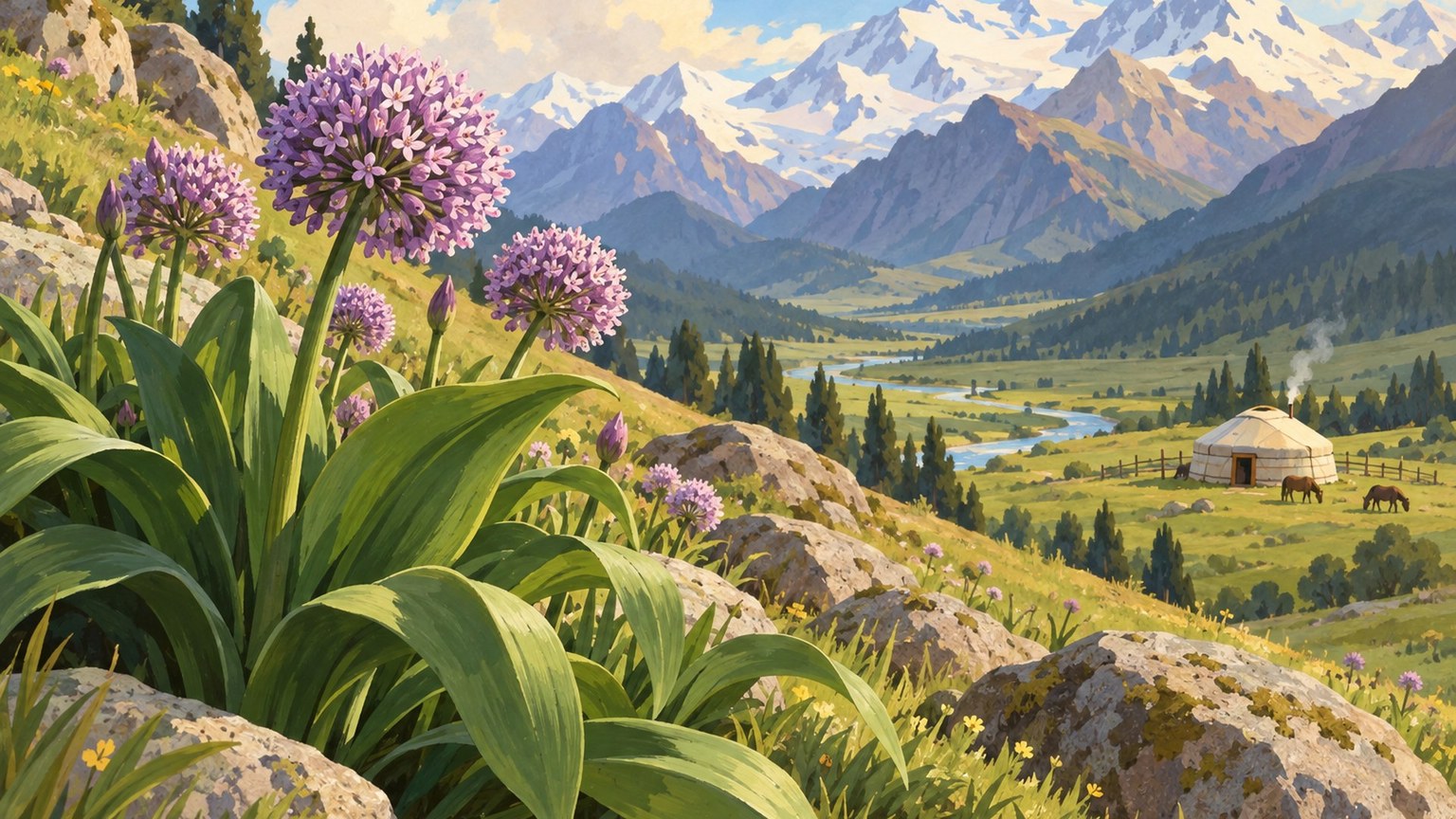
In the Tian Shan mountains of Central Asia, wild garlic still grows on the slopes, and its flowers can still make seed. The garlic in your kitchen almost never does. Here is how this one plant became food, medicine, bad manners and monster protection, and how to grow it.
Born in the mountains
Most botanists place garlic's origin in the Tian Shan, where Kazakhstan, Kyrgyzstan and China meet. People were growing it at least five thousand years ago. Garlic is planted from cloves, not seed, so every bulb is a copy of its parent. From the mountains it spread west to the Middle East, Egypt and the Mediterranean, and east into China.
In the oldest recipes
Garlic is already in the oldest written recipes we have: a Babylonian clay tablet from about 1750 BC, now at Yale, with 25 stews. Nearly every one is finished with crushed leek and garlic. All 25 are in The 25 Oldest Recipes in the World.
Food for builders
The Greek historian Herodotus wrote that an inscription on the Great Pyramid recorded what was spent on radishes, onions and garlic for the workers: 1,600 talents of silver, by his guide's reading. Historians think he was shown something else, perhaps visitors' graffiti. Real garlic did turn up in Egypt: clay models of bulbs were left in graves more than five thousand years ago, and bulbs were found in Tutankhamun's tomb. In the Bible, the Israelites in the desert miss "the leeks, and the onions, and the garlick" of Egypt (Numbers 11:5).
Medicine and muscle
Greek doctors of the Hippocratic school used garlic as medicine. In Rome, Pliny the Elder's Natural History (AD 77) listed dozens of garlic remedies, for everything from snakebite to coughs. It was everyday food for Roman soldiers, sailors and farm workers.
East on the Silk Road
Chinese tradition says the envoy Zhang Qian brought garlic back from Central Asia around 130 BC, though historians doubt the story. Today China grows about three quarters of the world's garlic: about 21 million of the world's 29 million tonnes in 2022.
Bad breath, good manners
Not everyone loved it. The Roman poet Horace wrote that garlic was more harmful than hemlock, after a garlicky dish set his stomach on fire. In India, Brahmin priests, Jains and many monks avoided garlic and onions as foods that stir the passions. And in The Canterbury Tales, Chaucer's Summoner, a pilgrim whose pimpled face scared children, "well loved he garlic, onions, and eke leeks."
Spirits and vampires
In folk belief across Europe, garlic hung by the door kept away evil spirits and the restless dead. In Bram Stoker's Dracula (1897), Van Helsing fills Lucy's bedroom with garlic flowers to keep the count away. A legend from the plague years tells of thieves who robbed the sick without catching it, thanks to vinegar steeped with garlic and herbs. It's a story, not medicine.
Why it smells
A whole clove barely smells. Crush it, and two substances kept apart in its cells (alliin and the enzyme alliinase) meet and make allicin, the sharp smell and bite of garlic. The American chemist Chester Cavallito isolated allicin in 1944 and found it killed some bacteria in the lab. Allicin breaks down quickly, and studies of garlic pills as medicine give mixed results.
How garlic grows
Garlic runs the other way round from most vegetables: plant it in autumn, dig it the next summer. A clove goes in point up, roots push down, a shoot rises, and the bed rests under snow. In spring the leaves grow fast; hardneck garlic sends up a curling flower stalk, the scape, while underground the clove splits into a new bulb. By midsummer the lower leaves brown, and the bulb is lifted, dried and split. The biggest cloves go back in the ground.
- Hardneck garlic grows scapes, peels easily and does best where winters are cold.
- Softneck garlic stores longer, can be braided and suits mild, southern gardens. Most supermarket garlic is softneck.
Which garlic, and when?
- Buy seed garlic from a nursery or local grower. Supermarket bulbs may carry disease or suit a different climate.
- Plant about 4–6 weeks before the ground freezes, often October in the north. Garlic needs a spell of cold to form a bulb. Find your frost dates on the zones page.
How deep, how far apart?
- Split the bulb just before planting and keep the biggest cloves.
- Set them point up, 2 inches deep and 6 inches apart, in rows 12 inches apart.
- Full sun, loose and well-drained soil, with compost worked in.
- Cover the bed with 4–6 inches of straw for winter. More in fall mulching.
What does it need in spring?
- When shoots are up, pull the straw back a little and give a feed high in nitrogen. Each leaf becomes a wrapper around the bulb, so more leaves mean a bigger bulb.
- Water about an inch a week and keep the bed weeded; garlic doesn't compete well with weeds.
- Snap off the scapes once they curl. The plant puts more into the bulb, and the scapes are good to eat.
- Yellowing leaves and white, fluffy mould on the bulb can mean white rot. Pull those plants, and don't grow garlic or onions there for many years. See our crop rotation plan.
When is it ready?
- Stop watering about two weeks before harvest.
- Dig when the lower leaves have browned but five or six are still green.
- Lift with a fork rather than pulling, brush off the soil, and don't wash the bulbs.
- Cure somewhere shady and airy for 2–4 weeks, then trim the roots and store cool and dry.
- Save your biggest bulbs to replant, and over the years you'll have a garlic that suits your own garden.
Everything else is on the Garlic page.
Sources: Genes & Genetic Systems 91(3) (2016) on garlic's centre of origin; Pooler & Simon 1994 on garlic seed; Herodotus, Histories 2.125; Numbers 11:5; Pliny the Elder, Natural History book 20; Horace, Epode 3; Chaucer, Canterbury Tales, General Prologue; Bram Stoker, Dracula; Cavallito & Bailey 1944 (Journal of the American Chemical Society); FAOSTAT 2022; University of Minnesota, Cornell and University of Maryland extension guides.









