High in the Andes, near Lake Titicaca, people have been growing potatoes for at least seven thousand years. From there the potato crossed the Atlantic, was distrusted, fed armies and empires, and became one of the world's biggest food crops. Here is its story, and how to grow it well.
Tamed in the Andes
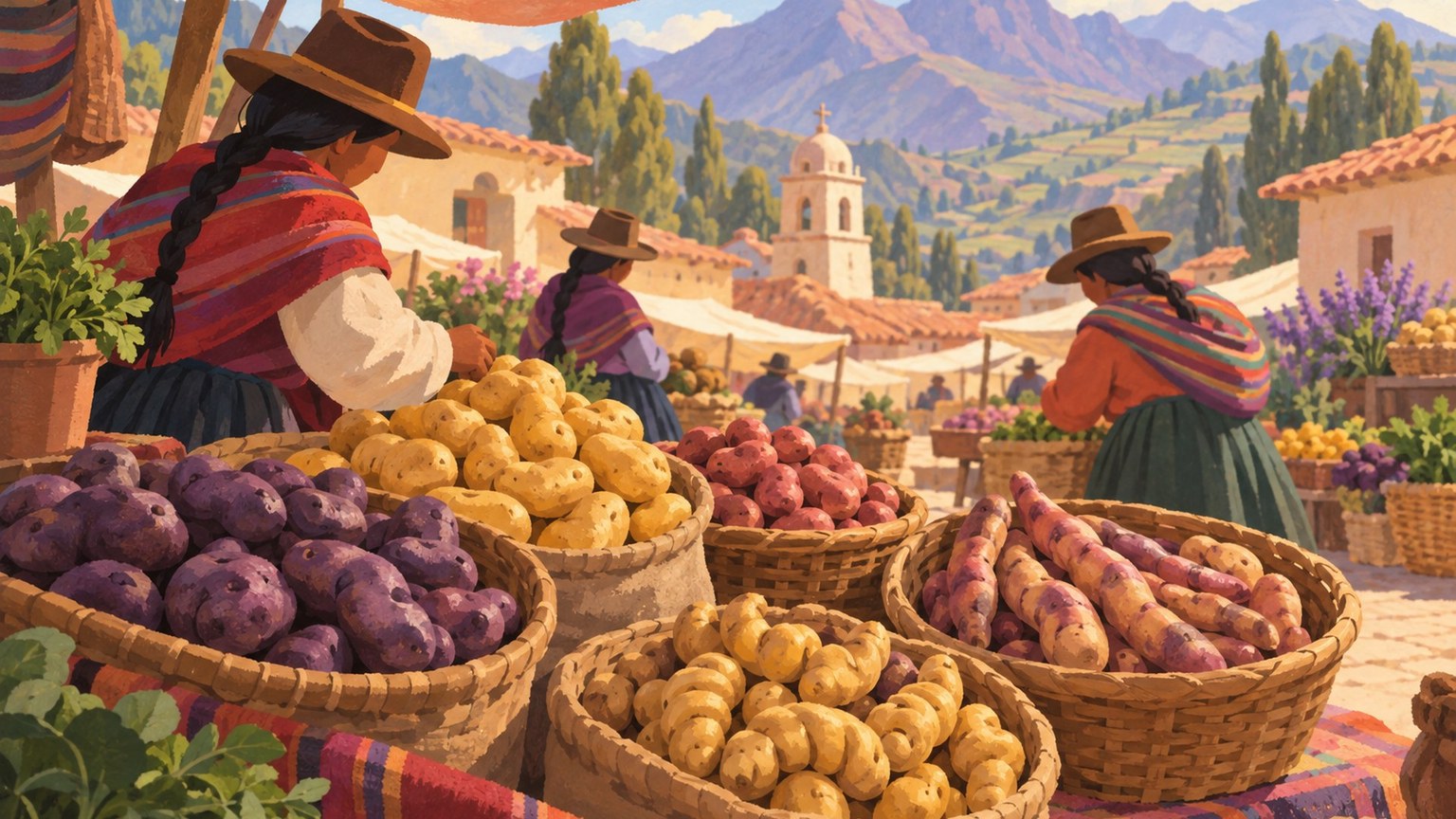
Wild potatoes are bitter, and some are poisonous. Andean farmers kept the plants with milder tubers and planted them again, year after year, on stone terraces up steep mountainsides where few crops survive frost and thin air. Over time they bred thousands of kinds, yellow, purple, red, long, round and twisted, and about four thousand are still grown in the Andes today.
The word comes from the Spanish patata, a blend of papa, the Quechua name, and batata, a Caribbean word for sweet potato.
Chuño: potatoes that keep for years
On frosty nights, Andean families spread potatoes on the ground; by day they tread on them barefoot to squeeze out the water. After weeks of freezing and drying, the potatoes become chuño, which keeps for years. The Inca stored it in stone storehouses along their roads to feed soldiers, workers and towns in bad years.
Across the ocean
Spanish soldiers reached the Andes in the 1530s looking for gold. They found silver at Potosí, where the miners were fed on chuño. Before long, potatoes were going aboard Spanish ships as food for the voyage, and by 1567 barrels of them were being shipped from the Canary Islands to Antwerp.
Europe was wary. The potato is a cousin of deadly nightshade, and its leaves and green berries are poisonous. Some people believed potatoes caused illness, and for a long time many were fed to pigs, or only to the poor.
Kings, chemists and a queen's hair
In 1756 King Frederick of Prussia ordered his farmers to plant potatoes and had seed handed out. One story says he had a royal potato field guarded, so people would think the crop was valuable and steal it. In France, the chemist Antoine-Augustin Parmentier, who had eaten potatoes as a prisoner of war in Prussia, campaigned for them for years; in 1772 the Paris medical faculty declared them safe to eat. By tradition, Marie Antoinette wore potato flowers in her hair. One study suggests potatoes may account for about a quarter of the growth in Europe's population between 1700 and 1900.
Ireland's Great Famine
In Ireland, potatoes thrived in wet, poor soil, and millions came to live mostly on them, many on a single variety, the Lumper, every plant a copy of the others. In 1845 late blight arrived. Leaves turned black and potatoes rotted in the ground.
The British government, which ruled Ireland, did too little. Its leaders believed the market would sort things out, and what relief there was came late and ended early. Grain, butter and cattle kept being shipped out of Ireland while the families who grew them had nothing to eat. With so little help, about a million people died and more than a million emigrated. Ireland's population fell from about 8.2 million in 1841 to 6.6 million in 1851, and kept falling for decades.
Around the world
Irish and Scottish settlers grew potatoes in New Hampshire from 1719. In the 1870s Luther Burbank raised a new potato in Massachusetts; a russet form of it, the Russet Burbank, is still the main potato for French fries. A popular story says potato chips were invented at Saratoga Springs in 1853, though recipes are older. In 1995 potato plants were grown on the space shuttle Columbia. Today China grows the most potatoes, followed by India.
How a potato grows
A potato isn't a root. It's a swollen underground stem, and its eyes are buds. Plant one and the eyes sprout; leaves rise while underground stems swell into new potatoes. When the plant flowers, the potatoes are forming; when the leaves yellow and die back, they're ready. Any small green berries after flowering are poisonous, like the leaves.
Planting
- Use certified seed potatoes. Supermarket potatoes can carry disease or be treated to stop sprouting.
- Choose early varieties for summer eating and maincrop varieties for winter storing.
- Chit them a month before planting: egg boxes, cool and bright, until sprouts are short and green. See how to chit seed potatoes.
- Give them full sun and loose, slightly acidic soil. Skip fresh manure and lime, which favour common scab.
- Cut large seed potatoes into egg-sized pieces with two eyes each and let the cuts dry for a day.
- Plant two to four weeks before your last frost, once the soil is about 45°F (7°C). Check your date on the zones page.
- Set them 4 inches deep and 12 inches apart, in rows 2–3 feet apart. More in how to plant seed potatoes.
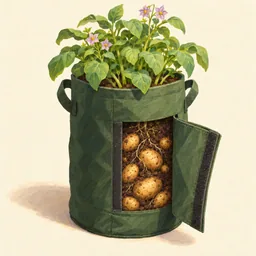
- No garden? Use a deep grow bag or tub and add potting mix as the stems grow.
Care
- Hill when shoots reach about 8 inches, and again every 2–3 weeks until flowering. Potatoes left in the light turn green, and green skin is bitter and mildly toxic. See how to hill potatoes.
- Water deeply, 1–2 inches a week, and keep it steady once they flower. Uneven watering gives knobbly or split potatoes.
- Check weekly for Colorado potato beetles and their orange eggs under the leaves.
- Dark, spreading leaf patches in cool, wet weather can be late blight. Pull affected plants and don't compost them.
- Rotate: leave three years before growing potatoes, tomatoes, peppers or eggplant in the same spot. See our crop rotation plan.
Harvest and storage
- New potatoes: dig carefully a couple of weeks after flowering.
- Storing potatoes: wait until the leaves have died back, then two more weeks so the skins toughen.
- Dig on a dry day, brush off the soil, and don't wash them.
- Cure somewhere dark for a week or two, then store at about 40°F in the dark, away from apples and onions. More in storing squash and potatoes for winter.
Everything else is on the Potatoes page.
Sources: Spooner et al. 2005 (PNAS) on domestication; International Potato Center; Hawkes & Francisco-Ortega 1993 on the 1567 Canary shipment; Nunn & Qian 2011 (Quarterly Journal of Economics); Britannica and RTÉ on the Great Famine and British relief; the 1841–1901 Irish census; FAOSTAT; University of Minnesota, Cornell and University of Maine extension guides.