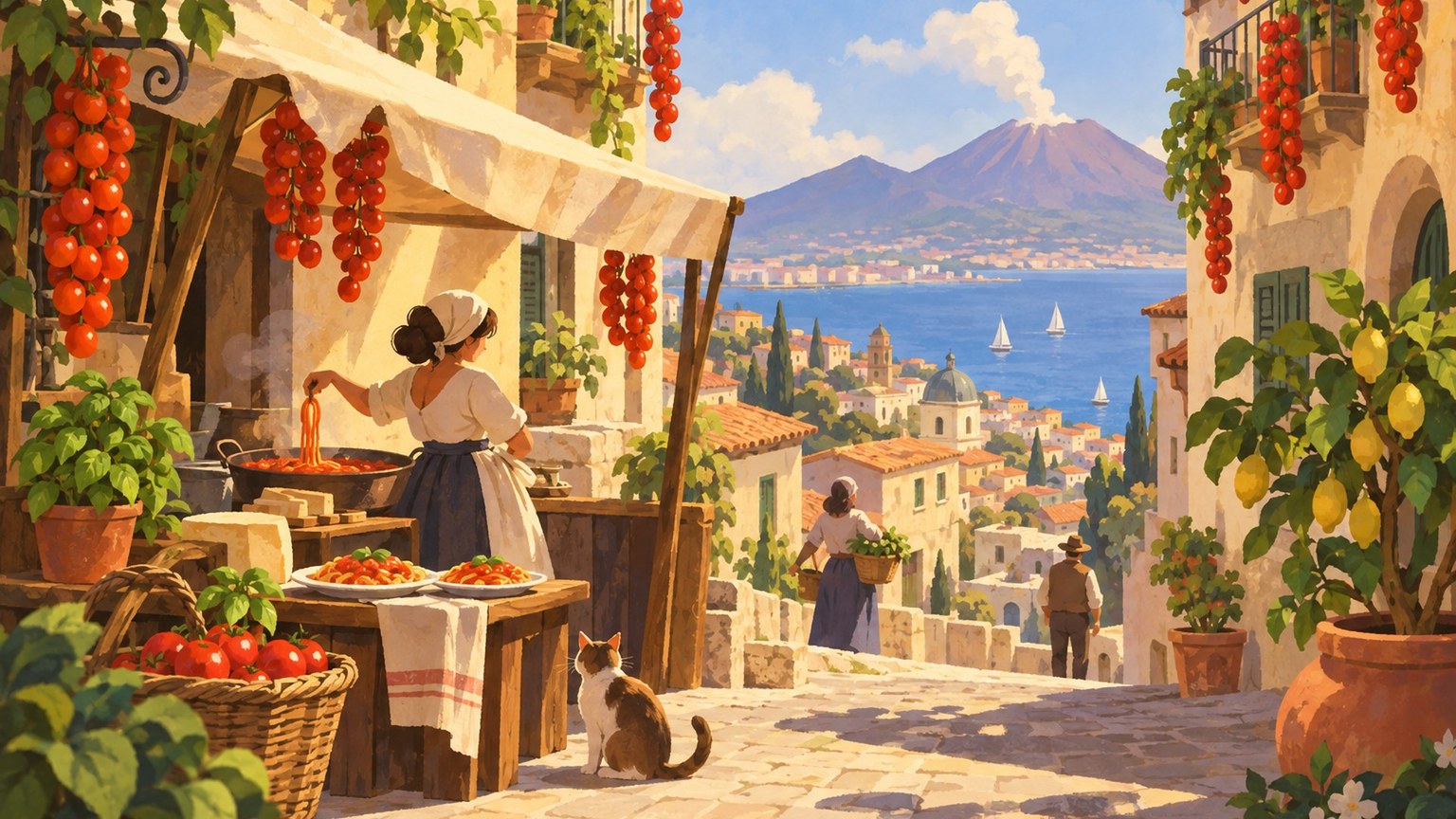
On the dry coast of Peru and Ecuador, wild tomato vines still scramble over the rocks. Their fruit is the size of a pea. From there the tomato went north to Mexico, across the ocean to Spain and Italy, and into the courts of the United States. Here is its story, and how to grow it, month by month.
Wild in the Andes
The wild currant tomato is the ancestor of every tomato we grow. DNA studies suggest people first tended it in Ecuador and northern Peru, and that it was carried north to Mexico, where farmers bred bigger fruit. Wild tomatoes are small but tough, and plant breeders still cross them into garden varieties to give them resistance to disease.
Xitomatl
The Aztecs called it xitomatl. Our word comes from it, by way of the Spanish tomate. A Spanish friar, Bernardino de Sahagún, wrote of cooks in the market selling sauces of tomatoes and chilies, much like a salsa today.
Golden apples
Spanish ships carried tomato seeds to Europe in the 1500s. In 1544 an Italian doctor, Pietro Mattioli, described the plant; ten years later he called the fruit pomi d'oro, golden apples, and the first tomatoes in Italy may well have been yellow. In 1548 a basket of them reached the Medici palace in Florence. For the most part, Italians grew them as a curiosity, not as food.
Spain ate them sooner. By 1608 a hospital in Seville was buying tomatoes for its patients.
Feared and admired
Like the potato, the tomato belongs to the nightshade family, and its leaves have a strong smell. Many people thought the fruit was poisonous. A popular story says rich Europeans fell ill after eating tomatoes off pewter plates, as the acid drew out lead; historians doubt it. An English herbal of 1597 called tomatoes "rank and stinking", and in England they stayed under suspicion for another century or more.
Naples and the sauce
Cooks in Naples were braver. In 1692 Antonio Latini published a recipe for tomato sauce "in the Spanish style", one of the first in print. Within a century, tomatoes were part of everyday food in southern Italy, and later they met pizza and pasta.
America
Thomas Jefferson grew tomatoes at Monticello, and his family cooked with them. A legend says Robert Gibbon Johnson ate a basket of tomatoes on the courthouse steps in Salem, New Jersey, in 1820, to prove them safe, but there's no record of it from the time.
Tomato ketchup recipes appear from 1812, and Henry Heinz began bottling his in 1876. In 1893 the US Supreme Court ruled, in Nix v. Hedden, that the tomato was a vegetable for the purpose of a tax on imports. Botanically, it's a fruit. In 1994 the Flavr Savr tomato became the first genetically engineered food sold in shops. Today China grows the most tomatoes, followed by India, Turkey and the United States.
How a tomato grows
A seed splits and sends down a root. Two smooth seed leaves come up, then the first true leaves, jagged and scented like the grown plant. The stem thickens and climbs, and clusters of small yellow flowers open. Each flower pollinates itself, but it needs a shake to let the pollen fall: wind does it, and bumblebees buzz the flowers. Where each flower was, a small green fruit swells, pales, blushes and turns red, full of seeds for next spring.
There are two kinds of plant. Bush (determinate) types stop at a set size and ripen their crop over a few weeks. Vining (indeterminate) types keep growing and fruiting until frost. New to tomatoes? Start with a cherry variety: quick, forgiving and happy in a large pot. Gardeners still save seed from old heirlooms like Brandywine, sold since the 1880s, and Cherokee Purple.
February: sow indoors
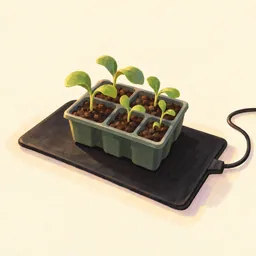
- Sow seeds 6–8 weeks before your last frost, about ¼ inch deep, somewhere warm and bright. Find your date on the zones page.
- Give them strong light, or they grow tall and weak.
- When the first true leaves open, move them into bigger pots. See how to start tomatoes and peppers indoors.
- A week or two before planting out, harden them off: a few hours outside each day, a little longer each time.
May: plant out
- Wait until nights stay above 50°F (10°C) and the soil is at least 60°F.
- Plant deep, burying the stem up to the first leaves. Tomatoes grow roots all along a buried stem.
- Space bush types about 2 feet apart and vining types about 3, with 3–4 feet between rows.
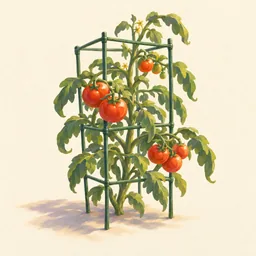
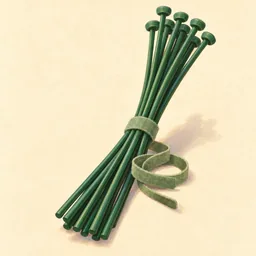
- Put in a stake or cage at planting time, so you don't spear the roots later.
Summer: water, feed, watch
- Water deeply, 1–1½ inches a week, and mulch to keep the soil evenly moist.
- A dark, sunken patch on the bottom of the fruit is blossom end rot. It comes from uneven watering, not disease. Fruit that splits usually follows heavy rain after a dry spell; steady watering helps there too.
- Feed with compost at planting and lightly once the first fruits set. Too much nitrogen gives big leaves and few tomatoes.
- On vining types you can pinch out the side shoots between the stem and a leaf branch. Leave bush types alone.
- Pick off tomato hornworms, but leave any covered in small white cocoons: those are parasitic wasps at work.
- Dark spots with rings on the lower leaves are early blight. Remove those leaves, keep the foliage dry, and rotate: don't grow tomatoes in the same spot two years running.
August: pick and save
- Pick when fully coloured and slightly soft when squeezed.
- Near the end of the season, bring green ones indoors to ripen on the counter.
- Keep them out of the fridge. Cold dulls their flavour.
- To save heirloom seed, scoop the seeds into a jar with a little water, let them ferment for a few days, then rinse and dry them.
So, fruit or vegetable? To a botanist, a fruit. To the Supreme Court in 1893, a vegetable. Everything else is on the Tomato page.
Sources: Razifard et al. 2020 (Molecular Biology and Evolution) on domestication; Sahagún's Florentine Codex; David Gentilcore, Pomodoro! A History of the Tomato in Italy (2010); Gerard's Herball (1597); Latini, Lo scalco alla moderna (1692); Thomas Jefferson Foundation; Andrew F. Smith, The Tomato in America (1994); Nix v. Hedden (1893); FAOSTAT; University of Minnesota, Cornell and University of Maryland extension guides.